
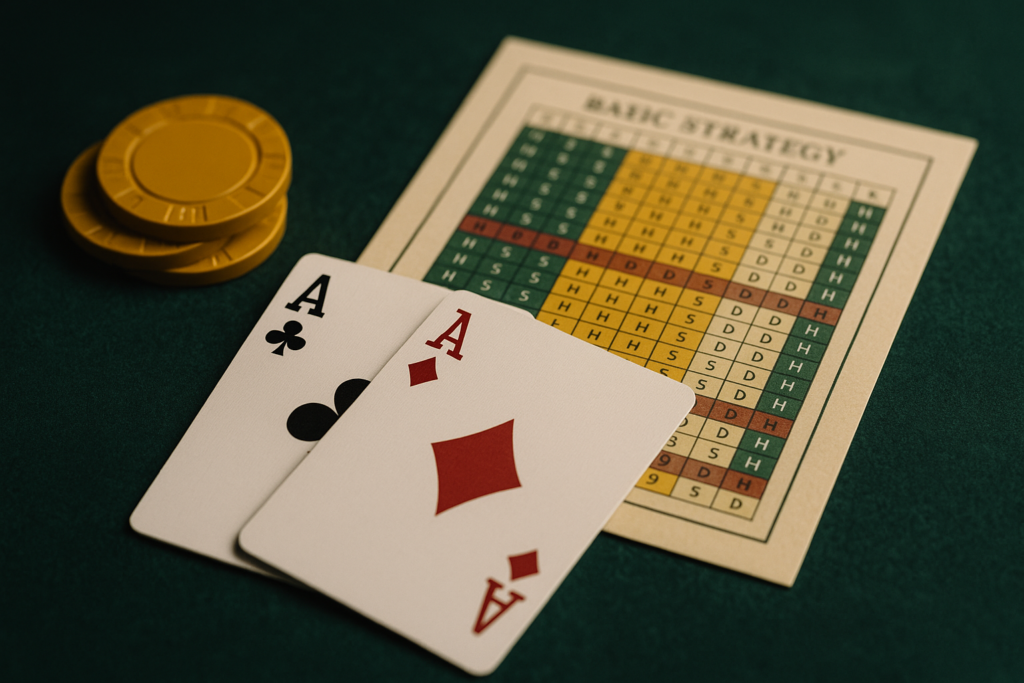
Blackjack Basic Strategy Chart: The Six‑Deck S17 Guide That Cuts the House Edge to ~0.41% — What to Memorize First
Estimated reading time: 6 minutes
Key takeaways
- Use the six‑deck S17 chart at six‑deck tables where the dealer stands on soft 17 to reduce the house edge to about 0.41%.
- Memorize six high‑impact plays first: stiff vs 4–6 stand, split aces and eights, double 10/11 when appropriate, stand on 17+, and don’t split tens or fives.
- Practice 20 minutes a day with flashcards, scenario drills, and speed rounds until actions become automatic.
Why the six-deck S17 blackjack basic strategy chart matters
Not every “basic strategy” is the same. The correct chart depends on table rules: number of decks, dealer soft‑17 behavior, doubling and surrender rules, and so on.
Use the wrong chart and you leave avoidable value on the table.
For the common casino configuration — six decks with the dealer standing on soft 17 — a correct basic strategy can reduce the house edge to about 0.41%.
That number comes from calculations collected by the Wizard of Odds.
0.41% isn’t a promise you’ll win. It indicates how close to break‑even perfect play gets over the long run.
By contrast, if the dealer hits on soft 17 in the same six‑deck setup, the edge jumps — Wizard of Odds shows an example around 0.93%. So the S17 vs H17 rule is material.
The single chart to use at most six‑deck S17 tables
Practical rule: if you’re at a six‑deck game and the dealer stands on soft 17, use the six‑deck S17 chart.
That chart is tailored to those rules and is what produces the ~0.41% house edge when played correctly.
Before you sit, confirm three table facts.
- Number of decks (is it six?).
- Dealer behavior on soft 17 (stands or hits?).
- Doubling and surrender rules (are doubles after splits allowed? is late surrender offered?).
Those details change the correct chart. If a table isn’t six‑deck S17, don’t treat the six‑deck S17 chart as gospel.
A basic strategy calculator or rule explainer that accepts table rules can double‑check which chart to use.
How to read the chart — fast
A basic strategy chart has three simple panels: hard totals, soft totals, and pairs.
Hard totals are hands with no usable ace (or where the ace counts as 1).
Soft totals have an ace counting as 11 (for example A‑6 = soft 17).
Pairs are matching cards you can split.
To use the chart: find your row (your hand), follow across to the dealer’s upcard column, and do what the chart says — hit, stand, double, or split.
If that sounds fuzzy, the Wizard of Odds has a clear walkthrough of how charts are structured and how to pick the right one for your rules.
What the six‑deck S17 chart tells you in plain English
I’m not pasting a full image of a chart here, but you need to internalize the rule patterns that matter most on that chart.
These are the specific, repeatable plays you’ll see again and again.
Hard totals
- Hard 17 or higher: Stand. Always. This is non‑negotiable.
- Hard 11 or lower: Hit — except when doubling is the right move (see doubling below).
- Hard 12–16: These are the tricky “stiff” hands. Stand when the dealer shows a weak upcard (usually 4–6). Hit when the dealer shows a stronger card.
Soft totals (with an ace)
- Soft 18 or higher: Usually stand, but there are exceptions depending on the dealer’s card and table rules.
- Soft hands often become doubling opportunities when the dealer has a weak upcard.
Pairs and splits
- Always split aces.
- Always split eights. Playing 16 is miserable; splitting eights turns one bad hand into two chances.
- Never split tens. Two tens is a 20 — stand and be happy.
- Don’t split fives. Treat a pair of fives as a hard 10 and consider doubling instead.
These baseline decisions are what the six‑deck S17 chart reinforces.
The six highest‑impact plays to memorize first
If you only have time to memorize six things, prioritize these plays in this exact order.
They move the house edge the most when you get them right.
- Stand on hard 12–16 vs dealer 4–6. Don’t try to win the hand; stand and avoid giving the dealer free cards.
- Split aces. Always split aces into two strong hands.
- Split eights. Always split eights to avoid playing 16.
- Double 10 or 11 vs suitable upcards. When you have hard 10 or 11 and the dealer shows a weaker upcard, double down for one extra card.
- Stand on hard 17+. 17 and up, you stand.
- Don’t split tens or fives. Keep tens as 20; treat fives as a 10 and look to double.
These six plays cover most meaningful decisions at the table. They’re the 80/20 of strategy.
Short practice routine to actually memorize blackjack strategy
Memorization works best when it’s focused and repeatable.
Here’s a simple 20‑minute daily routine to make the six plays second nature.
Day‑by‑day drill (20 minutes)
- Minutes 0–5: Flashcard warm‑up. Use a printed six‑deck S17 chart or an app and quiz yourself on the six plays. Call them out loud.
- Minutes 5–12: Scenario drill. Pull random hands or use an app and force an immediate action. If you hesitate, repeat until correct twice in a row.
- Minutes 12–18: Speed round. Give yourself 30 seconds per hand and aim for perfect accuracy on the high‑impact plays.
- Minutes 18–20: Reflection. Note two mistakes and remind yourself why the correct play is right to tie rule to reasoning.
Keep a printed or on‑screen chart nearby while learning. That’s allowed at most casinos when you’re learning.
Use the chart while you practice, then make it a habit.
Common table situations and how the six‑deck S17 chart handles them
Quick rules for situations that trip most players up.
- Dealer shows 4–6: If you have a stiff hard total (12–16), stand. This is a large EV swing.
- You have A‑6 (soft 17): Soft hands are flexible — you can hit or double in some spots depending on dealer card and rules.
- You have pair of 8s or Aces: Always split, regardless of upcard.
- Ten‑value pair: Never split. Keep the 20.
When in doubt, revert to the six‑deck chart for that game. The single rule that saves most mistakes is: stiff vs 4–6, stand.
Rules that change the chart (so check the table)
Here are table rules that materially alter the basic strategy you should use.
- Dealer hits vs stands on soft 17. H17 is worse for the player and shifts basic strategy; in an example six‑deck H17 the edge rises to about 0.93%.
- Number of decks. Fewer decks generally favor the player; edge numbers vary by deck count.
- Doubling rules. Restrictions on doubling or disallowing doubling after splitting change optimal plays.
- European/no‑hole‑card rules. These can be less favorable because a dealer blackjack can eat doubled or split wagers; the European chart assumes specific doublings and no hole card.
So check table rules before you lock into a chart. If unsure, ask the dealer whether they stand on soft 17 and how many decks are in play.
Putting it all together: quick checklist before you sit
- Confirm: six decks + dealer stands on soft 17? If yes, use the six‑deck S17 chart.
- Memorize the six high‑impact plays above — they produce most of the edge reduction.
- Practice 20 minutes a day with the routine above until reactions are automatic.
- Keep a printed chart while learning, but aim to internalize it within a few sessions.
Do those things and you’ll stop feeding easy mistakes to the dealer.
Useful references
If you want technical background, the Blackjack basics primer on Wizard of Odds explains the mechanics of basic strategy and edge figures.
Use the Strategy calculator to check which exact chart fits your table rules.
For deck‑count effects, read the Why number of decks matter page.
For a discussion of non‑six decks, see the Four‑deck strategy discussion.
If you need a European rules comparison, see the European rules example.
Frequently Asked Questions
What is a blackjack basic strategy chart and why use one?
A blackjack basic strategy chart is a rulebook of recommended actions — hit, stand, double, split — for every player hand against every dealer upcard.
It’s the mathematically best choice in the long run for a given set of table rules, and using the correct chart reduces the house edge substantially compared to guessing.
Which chart should I use at a six‑deck S17 table?
Use the six‑deck S17 basic strategy chart — the one that assumes six decks and that the dealer stands on soft 17.
That chart is the one that gets you to roughly the 0.41% house edge number when played correctly.
How do I memorize blackjack strategy quickly (memorize blackjack strategy)?
Focus on the six highest‑impact plays first: stand on 12–16 vs dealer 4–6, split aces and eights, double 10/11 when appropriate, stand on hard 17+, and don’t split tens or fives.
Use a 20‑minute daily drill of flashcards, scenario practice, and speed rounds until those reactions are automatic.
Does the number of decks really change the chart?
Yes. Number of decks affects the exact math and therefore some recommended plays.
In general fewer decks favor the player, and the Wizard of Odds provides illustrative edge numbers by deck count so you can see the difference.
Is basic strategy a guarantee I’ll win?
No. Basic strategy reduces the house edge and makes your play mathematically sound, but it does not guarantee profit.
It improves decision quality and reduces long‑term losses, but short‑term results still involve luck.
Can I use the six‑deck S17 chart at every casino?
Only if the table is actually six decks and the dealer stands on soft 17, and the doubling/surrender rules match the chart assumptions.
Always check the table rules first — if any of those things differ, pick the chart that fits the table.
Related guides: 7aBet Live · Mega Moolah jackpot: €1,000,000 seed, 88.12% base RTP · Buckshot Roulette review 12-gauge shotgun fuels tense duels · online casino bonus ohne einzahlung in deutschland: 5x–40x Umsatz, 100 € Limit