
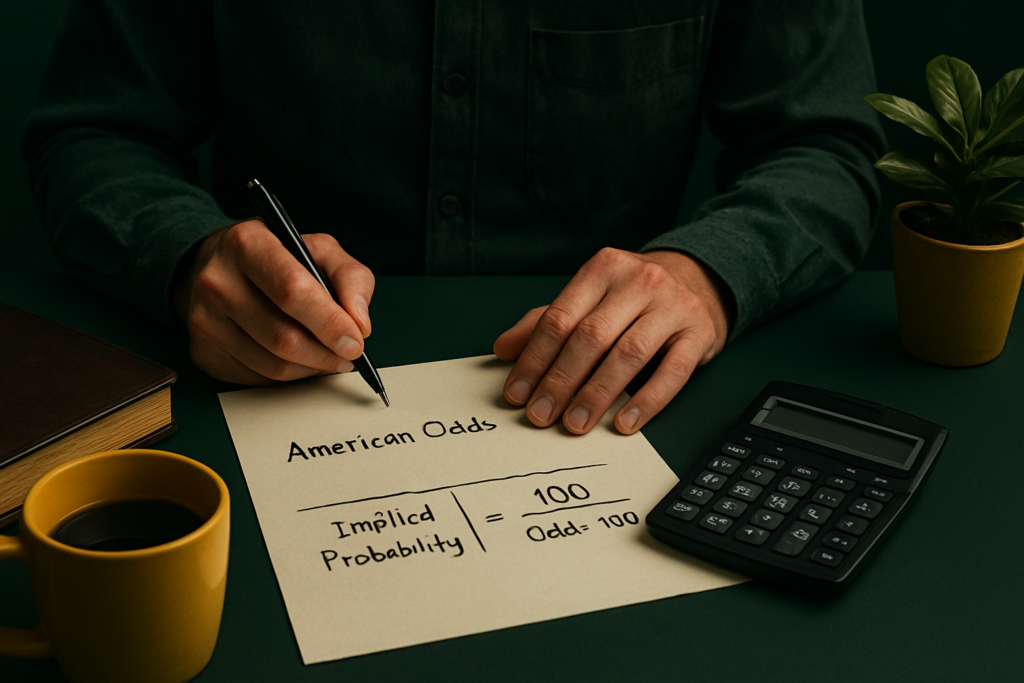
Convert American Lines to Implied Probability: +200 = 33.33%, -150 = 60% — how to strip out the bookmaker’s vig
Estimated reading time: 4 minutes
Key takeaways
- Two formulas convert American odds to implied probability: one for positive (+A) and one for negative (-A) odds.
- Bookmakers add a margin (vig/overround), so implied probabilities often sum to >100%; divide each probability by the market total to remove it.
- Normalization (no‑vig) works for two‑way and multi‑way markets — convert, sum, then divide each by the sum.
- Use the spreadsheet formula =IF(A1>0,100/(A1+100),ABS(A1)/(ABS(A1)+100)) for quick conversions.
american odds implied probability — the exact formulas (positive and negative)
There are two cases: positive American lines (the underdog style, e.g. +200) and negative American lines (the favorite style, e.g. -150).
Use the one that matches the sign on the ticket.
Positive odds (+A): the implied probability formula is
Implied probability = 100 / (A + 100) × 100
So for +200 you plug in A = 200 and get
100 / (200 + 100) × 100 = 33.33%.
Negative odds (-A): take the absolute value and use this:
Implied probability = A / (A + 100) × 100
For -150 use A = 150:
150 / (150 + 100) × 100 = 60%.
If you want a handy reference, sportsbooks and explainers have the same math — for a quick refresher see the DraftKings odds calculator explanation.
How to convert American odds to probability — quick examples you’ll actually use
Rather than rehash theory, here are the conversions you’ll see most often.
I’m sticking to the standard formulas, and these figures are the textbook results.
- +100 → 100/(100+100) = 50.00%
- +150 → 100/(150+100) = 40.00%
- +200 → 100/(200+100) = 33.33%
- +300 → 100/(300+100) = 25.00%
- -110 → 110/(110+100) = 52.38%
- -200 → 200/(200+100) = 66.67%
- -500 → 500/(500+100) = 83.33%
These are the same example figures shown in practical guides — if you want another plain explanation, Sporting News lays this out clearly.
Why implied probabilities often add to more than 100% (the vig / overround)
Here’s the annoying but important bit: the implied probability you calculate from a price reflects the sportsbook’s price, not the “true” chance the event occurs.
Bookmakers build a margin into the market — called the vig or overround — so the sum of implied probabilities for all outcomes is usually greater than 100%.
Example: a two-way market where each side is -110 has implied probabilities of 52.38% and 52.38%.
Add them up and you get 104.76%. That extra 4.76 percentage points is the bookmaker’s margin.
Want a plain definition? The overround is simply the total of the implied probabilities for all possible outcomes; anything above 100% is the bookmaker’s cushion.
For a practical primer, Oddsshopper explains overround and how it shows up.
How to strip out the bookmaker’s vig — no‑vig normalization, step by step
If you want to estimate a market’s “fair” probabilities (a no‑vig view), divide each implied probability by the total implied probability for the market.
That’s the simplest and most common normalization.
Two-way example: -110 and -110
Start with the lines: both sides are -110.
- -110 implied probability = 110 / (110 + 100) × 100 = 52.38%
- Other side is identical = 52.38%
- Market total = 52.38 + 52.38 = 104.76%
Now normalize: divide each implied probability by the total and convert to percent.
- No‑vig probability (side A) = 52.38 / 104.76 = 0.50 → 50.0%
- No‑vig probability (side B) = 52.38 / 104.76 = 0.50 → 50.0%
Result: after removing the vig, both sides are a clean 50/50 market. Nice and intuitive.
Two-way example: +200 and -150 (why totals can still be odd)
Let’s use the examples from the top: +200 → 33.33% and -150 → 60.00%.
- 33.33 + 60.00 = 93.33% (that’s under 100).
That can happen when the market is priced in a way that, after rounding, doesn’t push total over 100.
You can still normalize — divide each implied probability by 93.33 to get a no‑vig pair.
- No‑vig underdog = 33.33 / 93.33 = 0.357 → 35.7%
- No‑vig favorite = 60.00 / 93.33 = 0.643 → 64.3%
So normalizing works regardless of whether the market total is above or below 100; you’re just scaling the market probabilities until they sum to 100%.
Spreadsheet formulas and quick calculations (copy/paste friendly)
If you want to set this up in Excel or Google Sheets, here are the exact formulas to type into a cell.
I’ll use the convention that cell A1 contains the American odds (like +200 or -150).
- Implied probability (percent) for any American odds in A1:
=IF(A1>0, 100/(A1+100), ABS(A1)/(ABS(A1)+100))
- Normalized (no‑vig) probability when you have a column of implied probabilities (say B1:B2):
=B1 / SUM(B$1:B$2) (copy down)
That first formula is just the implied probability formula implemented in a sheet.
It handles positive and negative values in the same cell without you needing separate branches.
How to interpret the converted numbers — what they tell you (and what they don’t)
Once you’ve converted a price to an implied probability, you have a few practical pieces of information:
- Relative likelihood: a 60% implied probability means the market is pricing that outcome as materially more likely than a 33.33% outcome.
- Market bias: if the total is >100%, you can see how big the bookmaker’s margin is.
- Comparisons: converting several markets to no‑vig probabilities puts them on the same baseline (sums to 100%), which is handy when comparing across books.
What it doesn’t tell you is the true chance the event will happen — only the market’s view.
That’s why you’ll often see smart people compare several books, convert to implied probabilities, normalize for vig, and then make comparisons.
The math is neutral; interpretation is where judgment kicks in.
Practical tips, common mistakes, and why rounding matters
Quick, practical rules I tell mates who ask for the “easy” way:
- Always use the absolute value for negative odds in the formula — that step is where people slip up.
- Keep precision while calculating; round at the end. If you round each implied probability to two decimals and then add them, the market total might mislead slightly because of rounding error.
- Remember the market total as a diagnostic: if it’s 102–105% you’ve got a typical vig; anything extreme (like 120%+) is a sign the market is either mispriced or heavily skewed.
- Use the no‑vig normalization when you want a “fair” comparison across many prices — it’s the standard approach.
And one other small thing: people sometimes ask if there’s some secret “better” normalization.
The simple divide‑by‑total method is the go‑to because it’s transparent and conservative.
More complex models exist, but they bring assumptions — and for quick checks, simplicity wins.
Multi‑way markets (three outcomes and more): same idea, more numbers
For markets with three or more outcomes (soccer home/draw/away, race fields, etc.), the principle is identical: convert every price to its implied probability, add them all together, then divide each implied probability by the total to get the no‑vig percentage.
Concrete example using numbers from basic examples:
- Outcome A: +100 → 50.00%
- Outcome B: +150 → 40.00%
- Outcome C: +300 → 25.00%
- Total = 50.00 + 40.00 + 25.00 = 115.00%
Normalize each:
- No‑vig A = 50.00 / 115.00 = 43.48%
- No‑vig B = 40.00 / 115.00 = 34.78%
- No‑vig C = 25.00 / 115.00 = 21.74%
That leaves you with a 100% total and clean, comparable probabilities across the three outcomes.
It’s the same technique as the two-way example, just with more items to add and divide.
Where to check your calculations (tools and quick references)
If you’d rather not type formulas, there are online calculators that do this conversion instantly.
They’ll also show the implied probability and often the overround for an entire market.
I linked the sportsbook guide above, but plenty of calculators exist if you want to cross-check your numbers.
Whatever tool you use, make sure it’s showing you the same formulas we used here — the positive and negative formulas are the standard.
If the tool gives different results, double‑check the input sign and the way it handles rounding.
FAQs
Frequently Asked Questions
What is the american odds implied probability formula?
There are two formulas depending on the sign. For positive odds (+A): 100 / (A + 100) × 100. For negative odds (-A): A / (A + 100) × 100. Examples: +200 → 33.33%; -150 → 60%.
How do I convert American odds to probability quickly?
Plug the number into the right formula above. In a spreadsheet, use =IF(A1>0, 100/(A1+100), ABS(A1)/(ABS(A1)+100)) if A1 holds the American odds. That will return the implied probability as a decimal; multiply by 100 if you want percent form.
Why do implied probabilities add to more than 100%?
Because the sportsbook includes a margin — called the vig or overround — which inflates the total of implied probabilities above 100%. The difference between the market total and 100% represents that margin.
How do I remove the vig from a market?
Convert every price to its implied probability, sum those implied probabilities, then divide each implied probability by the sum. That gives you the normalized (no‑vig) probabilities that add to 100%.
Can I use this method for multi-way markets (like soccer 1X2)?
Yes. Convert each of the three (or more) prices to implied probabilities, add them, then divide each by the total. That gives you the no‑vig distribution for all outcomes.
Where can I find calculator help if my math doesn’t match?
Sportsbook help pages and betting explainers outline the same math we used. If you want a short guide, check the DraftKings odds calculator explanation or the clear primer from Sporting News. For overround discussion, Oddsshopper is useful.