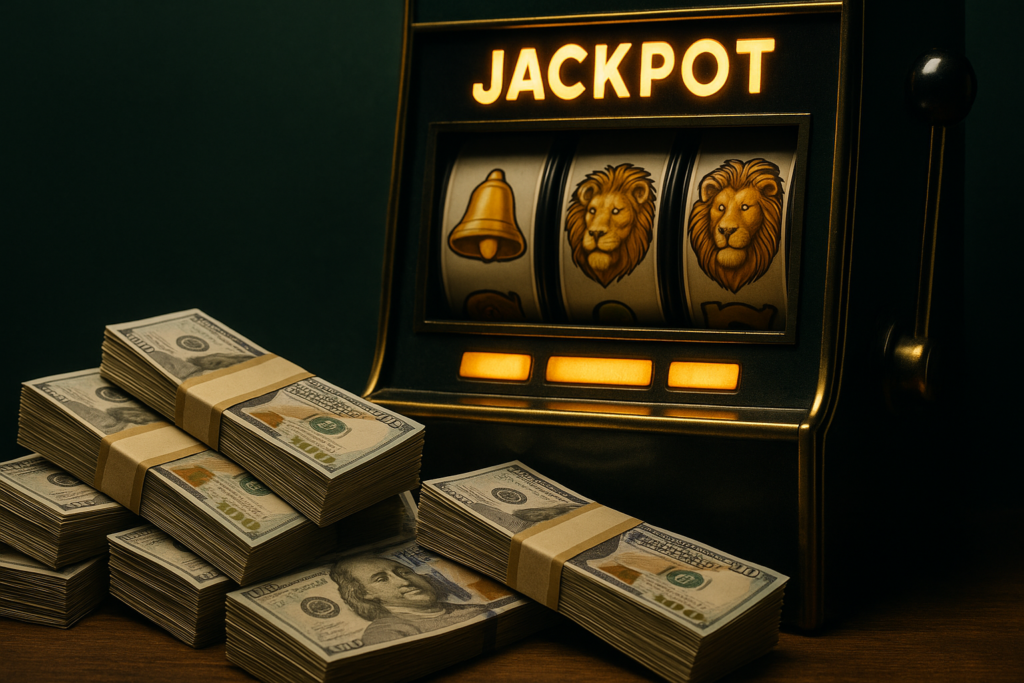
Mega Moolah jackpot: Why its 88.12% RTP means you’re paying to chase a ~1,000,000 top prize
Estimated reading time: 7 minutes
Key takeaways
- The published base-game RTP for Mega Moolah is ≈88.12%, meaning a theoretical house edge near 11.88% on ordinary spins.
- Estimated inclusive RTP figures (≈93.42%) suggest ≈5.3% of each bet is diverted to progressive pools across the network.
- At €1 bets, that ≈€0.053 per spin contribution would need roughly a 1-in-18.9-million chance to break even on a €1,000,000 Mega prize.
- Play for the thrill only with a firm budget — mathematically there are many higher-RTP alternatives if you prioritise long-term return.
Mega Moolah RTP: the numbers you need to know
Let’s cut to the core figures and not dance around the marketing.
The slot’s published base-game RTP of 88.12% is the one that applies to ordinary spins if you ignore the progressive pools entirely.
That’s a theoretical house edge of about 11.88% — meaning over a very long sample, the game pays back roughly €0.8812 for every €1 staked in the base game.
Now, people often point out a different number for Mega Moolah when the jackpot contribution is considered.
Some reviews peg the RTP including estimated jackpot contributions at about 93.42%, which lowers the overall house edge to around 6.58% — still below the 95%+ most mainstream slots advertise.
Those extra percentage points between the base and the inclusive RTP are the key here: they’re the portion of money siphoned off to fund the progressive jackpots.
How the progressive pools are funded
Mega Moolah’s jackpots — Mini, Minor, Major and Mega — don’t come from nowhere.
They’re grown through tiny slices taken from real‑money play across the machine’s connected network.
This is standard for progressives: a fraction of each wager is routed into the pooled prize.
You can read a plain description of that mechanic in the game’s network documentation and reviews, which explain the jackpots are funded by contributions from play across the linked machines and operators.
When people talk about the game being “low RTP,” what they usually mean is the base-game math is low and a chunk of player stakes is being diverted into those pools.
The difference between 88.12% and 93.42% gives us a simple handle on how big that chunk is across all four tiers.
How much are players paying — literally — per spin?
Here’s where the math gets useful and fairly brutal.
The RTP gap between the base game and the inclusive figure is 5.3 percentage points (93.42% − 88.12% = 5.3%).
That 5.3% is the estimated total contribution from each bet that goes into the jackpot pools (all four tiers combined).
Put another way: every €1 spin is effectively donating about €0.053 to the progressive pools.
Every $1 spin is doing the same in dollars.
It’s a small number per spin, but it accumulates fast across millions of wagers.
- €0.25 spin → about €0.01325 to the pools.
- €1 spin → about €0.053 to the pools.
- €5 spin → about €0.265 to the pools.
That 5.3% figure comes from comparing the published base math and the commonly cited inclusive RTP estimates, so treat it as the best available ballpark from independent reviews rather than a regulator-supplied forensic breakdown.
How many spins would it take to seed a €1,000,000 Mega Moolah jackpot?
If we imagine, for argument’s sake, that all of that 5.3% contribution went straight into the top Mega pot (it doesn’t in reality), we can get a clean upper-bound estimate for how many spins are needed to grow a €1,000,000 seed.
Divide the target (€1,000,000) by the per-spin funnel (for a €1 wager that’s €0.053). That gives:
1,000,000 / 0.053 ≈ 18,867,925 spins at €1.
So if every player wagered €1 and every penny of that 5.3% went to the Mega pot, you’d need roughly 18.9 million spins to accumulate €1,000,000.
Reality check: the progressive contribution is split across Mini, Minor, Major and Mega.
That means the actual number of spins feeding the Mega pot alone is much larger.
Since independent, public splits of those contributions aren’t standardised across operators, we can’t name the true split without guessing.
But the headline point remains: it takes a lot of stake volume to make a million-plus progressive.
Example math — what if only 20% goes to the Mega pot?
I’ll be explicit that this is a hypothetical example, not a documented fact: if only 20% of that 5.3% went to Mega, the per‑spin top‑jackpot contribution on a €1 spin would be €0.0106.
Then you’d need about 94.3 million €1 spins to collect €1,000,000.
That shows why jackpots can sit for long stretches before popping: they’re fed by a tiny slice of a huge number of wagers across a global network.
How to think about the odds: what break-even looks like
We don’t have a published single-spin probability for the Mega being triggered — the jackpot feature is described as a random award — so you won’t find an “official” 1-in-X chance in the game rules.
But you can ask a different, useful question: how rare would the Mega have to be for the jackpot to pay back the amount players collectively divert into it?
The break‑even single‑spin probability for the Mega equals (per‑spin contribution to Mega) divided by (jackpot size).
If you use the conservative upper-bound where the full 5.3% went to Mega, and you spin €1 bets, the required probability is:
0.053 / 1,000,000 = 5.3e‑8 ≈ 1 in 18.9 million.
So a €1 spin that gives up €0.053 to the pool requires around a 1‑in‑18.9‑million chance of winning €1,000,000 just to break even on that jackpot contribution alone.
Scale that by bet size:
- €0.25 bet → contribution ≈ €0.01325 → break-even ≈ 1 in 75.5 million.
- €1 bet → break-even ≈ 1 in 18.9 million.
- €5 bet → contribution ≈ €0.265 → break-even ≈ 1 in 3.77 million.
Again, those are the math break-evens under the simplifying assumption all the jackpot funding goes to the top tier.
If only a fraction does, the real break-even chance is correspondingly more punishing.
Mega Moolah odds and volatility — what the gameplay feels like
Independent reviews and guides characterise Mega Moolah as low-to-medium volatility.
That means ordinary spins will produce small wins reasonably often but not the big payouts you’d expect from high-volatility titles.
That low-to-medium classification helps explain the design philosophy: regular, modest payouts keep players playing while the progressive slice slowly accumulates across the network.
The top prize is the headline, but the game’s routine outcome pattern is tuned to longer play sessions rather than occasional massive swings.
The slot also leans on a simple bonus package — wilds that can double certain wins and a free-spins feature (commonly described as 15 free spins and a 3x multiplier in several write-ups) — to keep the core loop familiar and accessible.
What the math tells you about value — and what it doesn’t
Pure expected-value reasoning is unambiguous: if you only care about maximizing long-term return, there are plenty of slots with higher RTPs that will give you more value per euro wagered than Mega Moolah.
But that perspective misses why people play progressive slots in the first place.
For a lot of players the utility isn’t measured in cents per spin — it’s measured in the entertainment of chasing a life-altering prize.
That’s entirely valid, provided you accept the math upfront.
So when does it “make sense” to play Mega Moolah?
- If you’re paying for the thrill of a shot at a million rather than looking for steady edge‑maximizing play.
- If the amount you can afford to lose corresponds to the entertainment value you get — treat the per-spin jackpot contribution as a ticket price.
- If you’ve checked the operator’s paytable and game panel so you know actual bet limits and the displayed jackpot in your market.
When does it not make sense?
- If you’re trying to eke out the best mathematical return — there are better RTP choices.
- If you can’t accept frequent losing sessions without chasing losses — the progressive doesn’t make the average spin profitable.
- If you misunderstand the jackpot mechanics: the Mega is rare, triggered randomly, and fed by the whole network.
Practical tips before you chase that Mega Moolah jackpot
Here are the actionable things I always check when I'm tempted to spin for the top prize.
- Check the game panel. The specific RTP presentation, bet limits and any local differences live in the slot’s info screen. Rules and displayed numbers can vary by operator and market.
- Know the jackpot display. The progressive amount you see on your screen is market/operator-specific — the million-plus seed is a common starting point but it’s not identical everywhere.
- Decide a bankroll for “fun tickets.” Treat the per-spin jackpot contribution as an entertainment cost. Set a budget you’re comfortable losing and stick to it.
- Watch multiple sessions if you can. Because volatility is low-to-medium, you’ll see small wins that can look promising; they don’t change the underlying math.
- Remember the network. The pools are funded by many players across many operators — you’re not just competing against one machine or one casino.
If you want a single checklist item to sum it up: check whether you’re buying excitement or expecting value. The two aren’t the same with Mega Moolah.
How reliable are the reported Mega Moolah RTP and jackpot figures?
Short answer: the public figures come from developer and review pages, but operators can present slightly different interfaces and the progressive split is not publicly standardised.
Sources like industry reviews compile and explain the game's base math, features and network-funded jackpots.
They’re reliable for ballpark understanding, but for the absolute definitive numbers you should look at the slot’s information panel where you’re playing — that’s the legally binding presentation for that operator and market.
When the chase is emotionally rational
Math can tell you you’re paying for entertainment, but it can’t tell you whether that entertainment is worth €10 an hour, €50 a night, or more.
That’s individual. Here are a few scenarios where paying the negative expectation consciously is sensible:
- You’re on a budget, want a specific entertainment time, and the ticket price (the per-spin loss expectation) fits that budget.
- You value the dream of a life-changing win more than incremental return. That’s a personal utility decision, not a math error.
- You already accept that you’ll likely lose money but want a memorable session — a small number of spins at a higher stake can feel more exciting and costs less time than grinding tiny bets forever.
Contrast that with cases where it’s not sensible: chasing losses, thinking the jackpot is “due,” or treating the progressive as a savings vehicle. Those are clear traps.
Quick note on regulation and transparency
Progressive mechanics are legal and standard in regulated markets, but transparency varies.
Some jurisdictions force operators to explain contribution splits and probability models; many do not.
That’s why the independent review numbers are useful but never a substitute for the in-game info panel and your own budgeting discipline.
Remember too that the pools themselves are network-funded, meaning a lot of unrelated spins contribute to jackpot growth — your chances on any single spin are microscopic, and your money funds both the regular payback and the big prize.
FAQ
Frequently Asked Questions
What are the Mega Moolah odds of winning the Mega Moolah jackpot?
There isn’t a publicly published single-spin probability for the Mega prize in the game rules. The jackpot is described as a random award, and independent reviewers therefore use expected-value reasoning rather than an explicit odds figure. If you want a practical comparison: a €1 spin where about €0.053 goes to the pooled jackpots requires roughly a 1-in-18.9‑million chance of winning €1,000,000 to break even on that jackpot contribution alone (assuming all jackpot funding went to the Mega, which in reality it doesn’t).
How much does Mega Moolah’s RTP differ from other slots?
The published Mega Moolah RTP for the base game is around 88.12%, which is lower than many modern online slots that often sit in the mid-90s. Even when you include estimated jackpot contributions (some reviews quote ≈93.42%), the overall figure is still below many mainstream titles. That gap is the cost of funding the progressive jackpots.
How does the Mega Moolah progressive jackpot work?
The Mega Moolah progressive jackpot is one of four linked tiers that grow via small contributions from wagers across the connected network. The top tier is normally seeded at about one million in the local currency and increases with network play until it’s randomly awarded. The progressive pools are funded from real-money gameplay across the network rather than a single machine.
Is chasing the Mega Moolah jackpot a smart strategy?
“Smart” depends on your goal. If your goal is long-term return, there are better RTP choices. If your goal is entertainment and the thrill of a realistic shot at a life-changing prize, then it can be reasonable — provided you accept the negative expected value and set a firm budget. Treat the progressive slice as the price of a lottery ticket embedded in a slot.
Where can I find the exact numbers for the version I’m playing?
Always check the slot’s information panel at the operator you’re using. Paytables, bet limits, and how the jackpots are displayed vary by market and casino, and the in-game panel is the authoritative source for that operator.
Related guides: 7aBet Live · Mines casino review 2026 shows 99% RTP wins over 95% · Buckshot Roulette review 12-gauge shotgun fuels tense duels · online casino bonus ohne einzahlung in deutschland: 5x–40x Umsatz, 100 € Limit